
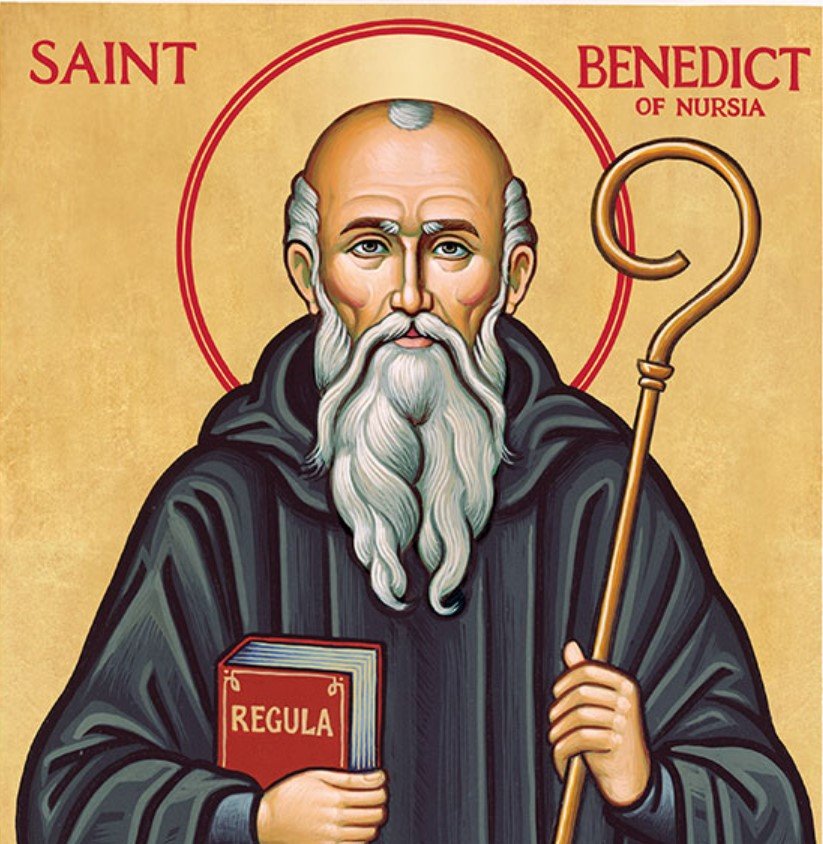
Benedict was born in the fifth century, around the year 480. He was essential for the development of European culture and civilization as we know it today. 1
The Rule of Saint Benedict (The Rule) was formulated by the influence of desert fathers such as Augustine, Caesarius of Arles, Basil of Caesarea and John Cassian. 2 It was created to promote the values of monastic life and instruct the brothers to live under the obedience of an abbot and a single rule.
The purpose of the document was also to guide the communities to be independent of one another.2 This is something that still is true today.3 The early monastic fathers and mothers sought solitude and silence would allow the monks to know God better and get the chance to contemplate “The Word” (John 1: 1).
By their influence, silence, humility, and obedience turned crucial elements to the way of living of the benedictine monks. Chapters five, six and seven are central to The Rule, bringing Benedict’s thoughts on such matters into the light. However, we can find references to these critical aspects of Benedictine’s life, implicit or explicitly, in several other chapters.
For instance, chapter 33 talks about private ownership. Benedict says, “no one should presume to give or receive anything without the abbot’s permission, or to possess anything of his own”, 4 a reference to humility and obedience. Humility to submit their own will to the abbot’s and obedience when accepting his decision on the ownership of things.
Another consideration to humility and obedience can be found in chapter 55 “The monks should not complain about the colour or thickness of all these items (clothing and footwear) but be content with what is to be found locally and what can be bought cheaply” .4
This reflection will have its fundamental focus on chapter six of The Rule and on the values of silence, obedience, humility and mainly laugh, to me the most unforeseen component present in The Rule. (cont.)
1 Pope Benedict XVI, Great Christian Thinkers from the Early Church through the Middle Ages (SPCK, 2011). p.126129. 2 Linda Woodhead, An Introduction to Christianity, Fourth (Cambridge University Press, 2008). p.99-100 3 Diarmaid MacCulloch, A History of Christianity (Penguin Books, 2010). p.318 4 Benedict, The Rule of St. Benedict, ed. by Carolinne White, Pengiun Books (Penguin Group, 2008)..
 The Theology Corner
Leave a comment