
Dogmas are truths of faith revealed by God and are part of the deposit of faith entrusted to the Church. Dogmas are infallible and irrevocable teachings of the Catholic Church, based on divine revelation as found in Sacred Scripture and Sacred Tradition.
The Marian dogmas are, therefore, a set of beliefs that pertain to the Virgin Mary. These dogmas are considered central to Catholic theology. Four Marian dogmas address different aspects of Mary’s role in salvation history and her relationship with God.
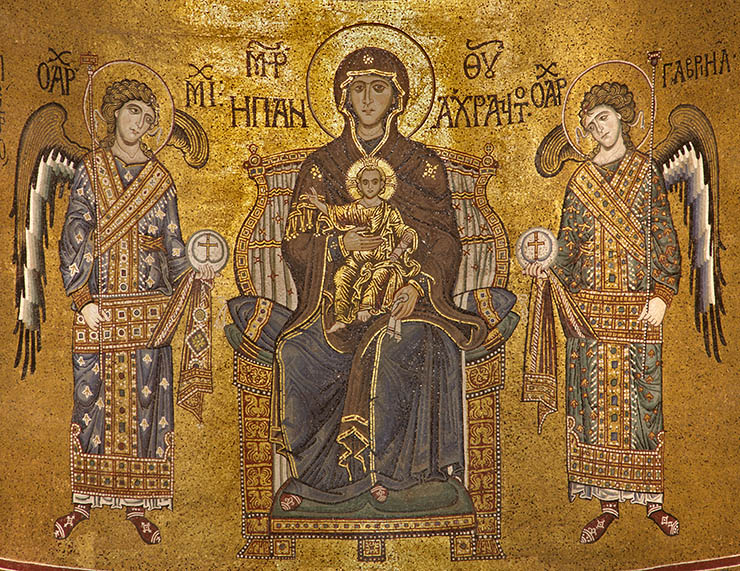
The first is the dogma of Mary’s Divine Motherhood. Mary’s divine motherhood was proclaimed at the Council of Ephesus in 431. This dogma states that Mary is the mother of God (Theotokos in Greek) because she gave birth to Jesus, who is both fully human and divine. This dogma emphasises the unity of Jesus’s divine and human natures and affirms Mary’s unique and exalted role in the Incarnation. Although there was no separate declaration of Mary’s Divine Motherhood, it is included in texts that define Jesus Christ’s person and nature. As a result, it is now a crucial part of the Christological dogma. This fact does not reduce its definitive and binding nature, and all Christian denominations widely accept it.
The second is the dogma of Mary’s Perpetual Virginity. Since the beginning of the Church, it has been professed in baptismal formulas and professions of faith that Jesus Christ was conceived solely by the power of the Holy Spirit, without any human seed. This is why phrases such as “conceived in the womb of the Virgin Mary,” “Mary’s virginal conception,” or “virgin birth” are so significant. The early baptismal formulas (dating back to the 3rd century) stated Mary’s virginity without further explanation, but it was clearly understood to have a physical meaning. Later statements were more explicit, affirming that Mary remained a virgin even after giving birth to Jesus: “without any detriment to her virginity, which remained inviolate even after his birth” (Council of the Lateran, 649).
The Catholic Church firmly believes that Mary was a virgin before, during, and after the birth of Jesus Christ, although this has not been explained in great detail. This highlights Mary’s unique and significant role as the mother of Jesus. The Vatican II also reaffirmed this belief and stated that Mary’s virginity was not affected by the birth of Christ, but rather, it was sanctified. The Catechism of the Catholic Church explores the profound significance of Mary’s perpetual virginity and her identity as a virgin bride (499-507). Additionally, the Church maintains that Jesus was Mary’s only child and that the “brothers and sisters” mentioned in the Bible were close relatives.
The third is the dogma of Mary’s Immaculate Conception. It teaches that Mary was conceived without the stain of original sin, anticipating her role as the Mother of Jesus. This dogma does not imply that Mary did not need redemption; rather, it affirms that her redemption was applied to her at the moment of her conception.
In 1854, Pope Pius IX, in his Apostolic Constitution “Ineffabilis Deus”, stresses the dignity and holiness required to become “Mother of God.” The privilege of the Immaculate Conception is the source and basis for Mary’s all-holiness as Mother of God.
According to the doctrine of the Immaculate Conception, the Virgin Mary was free from original sin from the moment of her conception due to the grace and privilege bestowed upon her by Almighty God and the merits of Jesus Christ.
The fourth dogma is the dogma of Mary’s Assumption into Heaven. This dogma was proclaimed by Pope Pius XII in 1950 in his Encyclical “Munificentissimus Deus” and asserts that at the end of her earthly life, Mary was taken body and soul into heavenly glory.
A distinction needs to be made between Ascension and Assumption. Unlike Jesus, who ascended into heaven by his power, Mary’s Assumption was a gift and grace from God, testifying to her unique holiness and participation in the Resurrection. The dogma states, “Mary, Immaculate Mother of God ever Virgin, after finishing the course of her life on earth, was taken up in body and soul to heavenly glory.”
The definition of the Assumption, along with that of the Immaculate Conception, is based on the Magisterium’s agreement and the faithful’s belief. The Assumption has been a part of the Church’s spiritual and doctrinal heritage for centuries, reflected in both theological contemplation and liturgical practices, and is widely accepted among the faithful.
The belief in the Assumption of Mary is not directly mentioned in scripture but is considered “divinely revealed” as implied in divine Revelation. This belief is seen as the natural result of Mary’s purpose in life and her close relationship with God, and her mission. The Assumption highlights Mary’s role as a Divine Mother and her close association with her Son on earth and in heaven. As she was a devoted partner and helper to her Son on earth, it is fitting that this partnership continues in heaven. Mary’s connection to her Son is unbreakable in life and the afterlife.
Even in heaven, Mary remains actively involved in salvation history. She continues to fulfil her salvific duty and cares for her Son’s brothers and sisters who still journey on earth through her maternal love. As the “eschatological icon of the Church,” Mary represents the Church’s own end of times, and the Church contemplates this in her.
These Marian dogmas highlight the Catholic Church’s profound reverence for Mary and her place within the divine plan of salvation. They affirm her unique and privileged role in the life of Jesus and the Church. The dogmas are not mere theological constructs but are believed to have a profound impact on the spiritual life of the faithful.
For us Catholics, devotion to Mary is seen as a means of deepening our relationship with Jesus. Through her example, we seek to imitate her virtues and entrust ourselves to her intercession. Mary is viewed as the perfect disciple who said “yes” to God without reservation and remained faithful throughout her life.
 The Theology Corner
Leave a comment